The most technically complete inulin resource in Europe — with solubility charts, glycaemic index comparison, processing stability matrix, SCFA fermentation data, bakery application guide, and an interactive sweetness modulator. Native chicory inulin from EU stock, 25 kg minimum, CoA per batch.
What makes inulin uniquely functional — four pillars
Inulin is not simply a fibre — it operates across four distinct functional dimensions simultaneously. Understanding each pillar allows optimal formulation decisions and differentiating product claims.
🦠
Selective Prebiotic Fermentation
Inulin's β(2→1) bonds resist all human digestive enzymes, delivering substrate selectively to Bifidobacterium and Lactobacillus — which possess specific β-fructosidases. Competing pathobionts (Clostridia, Proteobacteria) cannot ferment inulin efficiently, giving bifidogenic selectivity a competitive advantage in the colon ecosystem.
Bifidogenic index (BI) = Bifido growth / Total bacterial growth Native inulin BI: 7.1 · FOS BI: 9.2
🫙
Fat Replacement via Gel Microstructure
Above ~15% concentration in water, inulin (especially HP-inulin, DP >23) forms helical crystal aggregates 0.1–2 μm — the same size range as emulsified fat globules. This creates thixotropic gels that mimic fat mouthfeel, lubrication, and flow behaviour. The substitution ratio is 1g fat = 0.25g inulin + 0.75g water, saving 87% of the calories in the replaced portion.
1g fat (9 kcal) → 0.25g inulin (0.4 kcal) + 0.75g water Calorie saving: 8.6 kcal per gram of fat replaced
📉
Zero Glycaemic Impact
Inulin's β(2→1) linkages are not cleaved by human α-amylase, sucrase-isomaltase, or any brush-border enzyme. It therefore reaches the colon intact — GI = 0, insulin index = 0. At the same time, inulin contributes ~10% of sucrose sweetness, rounds the flavour of high-intensity sweeteners, and reduces their aftertaste — making it essential in sugar-reduction formulations targeting zero glycaemic impact.
GI = 0 · Insulin index ≈ 0 · Caloric value: 1.5 kcal/g vs Sucrose: GI 65, 4 kcal/g
🧬
SCFA Production & Gut Barrier
Colonic fermentation of inulin produces acetate, propionate and butyrate — collectively 5–6 mmol SCFA per gram substrate. Butyrate is particularly critical: it provides 70% of colonocyte energy, upregulates tight junction proteins (claudin, occludin), and suppresses pro-inflammatory NF-κB signalling. Long-chain inulin (HP) produces more butyrate per gram than FOS because distal colon fermentation favours Faecalibacterium prausnitzii.
Total SCFA yield: 5–6 mmol/g substrate (24h in vitro) Butyrate: 0.6 (FOS) → 1.8 mmol/g (HP-inulin)
DP (Degree of Polymerisation) — the master variable
Every functional property of inulin is governed by its degree of polymerisation. The DP of a molecule is simply the number of fructose units in the chain. Native chicory inulin has a distribution from DP 2 to DP 60, with an average of approximately 12.
Short chains (DP 2–10, FOS): soluble even in cold water (>40g/100ml at 20°C), rapidly and preferentially fermented by Bifidobacterium in the proximal colon, higher sweetness (~35% of sucrose), no gel formation, highest bifidogenic index (9.2). Best for supplement sachets, functional beverages, rapid bifidogenic response.
Native chains (DP 2–60, average ~12): 10g/100ml solubility at 20°C, moderate fermentation rate (proximal and mid-colon), ~10% sweetness, good fat replacer in gel form above 20%. Optimal balance for most food applications. This is what FDCM supplies.
Long chains (DP >23, HP-inulin): very low cold-water solubility (3g/100ml at 20°C), fermented slowly in mid-to-distal colon producing maximum butyrate, <5% sweetness, excellent fat replacer — forms stable gel at ≥15%, creating true fat-like microstructure. Required for high-performance fat replacement in dairy systems where native inulin creates insufficient gel strength.
FDCM supplies native inulin (DP 2–60) — optimal for >90% of food applications including fat replacement (up to 30–40% at realistic dosages), fibre enrichment, prebiotic function, and sweetness modification. Request HP-inulin specification if your application specifically requires DP >23 for maximum gel strength.
Chicory — the source
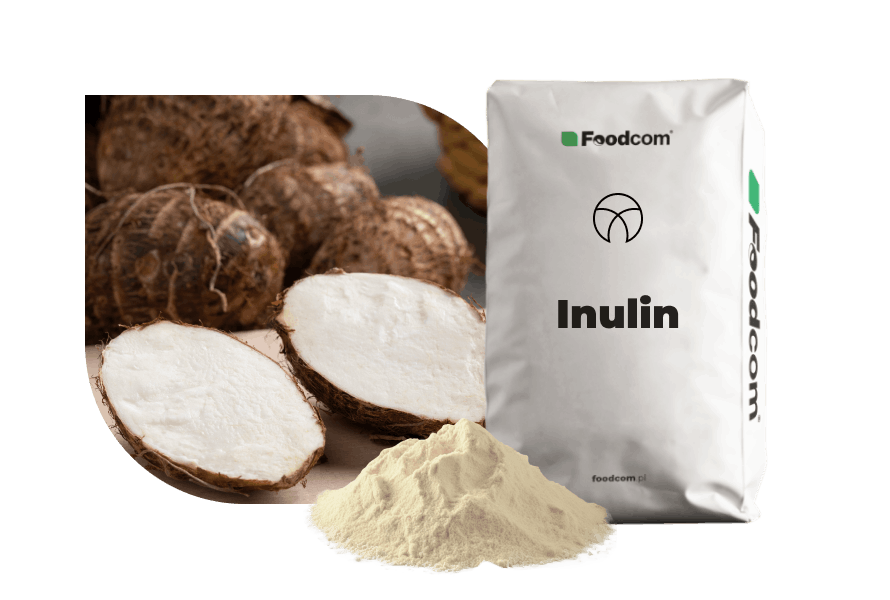
Chicory (Cichorium intybus) stores inulin as a carbon reserve in its taproot. The plant is grown commercially in Belgium, France, the Netherlands and Germany — making EU-produced inulin genuinely local. Harvest occurs in autumn when root inulin content peaks.
Extraction process — no solvents
1
Slicing & washing — roots sliced into cossettes, washed to remove soil
2
Hot water diffusion — 70–80°C extraction, identical to sugar beet
3
Purification — filtration, carbonatation, ion exchange to remove impurities
4
Concentration — evaporation to syrup (55–60% dry matter)
5
Spray drying — atomisation into 100–200°C air → white powder
6
Sieving & packaging — 25 kg food-grade bags, CoA per batch
Clean label status: No E-number. Declared as 'chicory inulin' or 'inulin'. Approved for organic production (EU 2018/848). No allergen classification (EU 1169/2011). Not a food additive — a food ingredient with quantum satis use in food.
Interactive chart · unique data
Inulin solubility vs temperature — native, FOS, HP-inulin and sucrose
Solubility (g per 100 ml water) at five temperatures for three inulin types and sucrose as reference. This chart reveals the critical formulation constraint: HP-inulin's low cold solubility but unique gel-forming capability, and the dramatic difference between FOS and native inulin at cold temperatures.
Solubility (g / 100 ml water) — log scale notice: sucrose values are 10–30× higher than inulin
Native Inulin (DP~12)
FOS (DP 2–5)
HP-Inulin (DP>23)
Sucrose (reference)
Data: literature values at equilibrium. Native inulin: ~10 g/100 ml at 20°C; FOS ~65 g/100ml; HP-inulin ~3 g/100ml. Supersaturation of inulin at cooling causes creamy gel formation (HP-inulin >15%) — the basis of fat replacement functionality.
Why solubility matters for your formulation
Inulin's temperature-dependent solubility directly constrains how much you can add to a product without causing crystallisation on cooling. At 20°C, native inulin saturates at ~10 g/100 ml — so a cold-fill beverage can hold at most ~9 g/100 ml before crystallisation risk. A hot-fill product at 60°C can dissolve ~50 g/100 ml, which then on cooling either forms a gel (HP-inulin) or supersaturates slowly (native inulin, taking weeks to crystallise).
Crystallisation in practice: In yogurt or cream cheese containing >15% native inulin, slow crystallisation during storage can create a sandy mouthfeel ('retrogradation'). Prevention: (1) use HP-inulin which forms a stable gel rather than crystals, (2) limit native inulin to <10% in refrigerated products, (3) add co-solutes (erythritol, sorbitol) which interfere with inulin crystal packing.
HP-inulin gel formation mechanism
HP-inulin (DP >23) dissolved at >80°C then cooled forms an irreversible gel network of needle-like crystals 0.1–2 μm. This is not a thermal gel like gelatin — it's a cold-setting crystal gel. The mechanism: long fructan chains adopt helical conformations that align and aggregate via hydrogen bonding during cooling. The resulting network is:
Thixotropic — flows under shear (spreadable), recovers at rest
Heat-stable above 60°C — melts slowly above 60°C, unlike gelatin (melts at body temperature)
Freeze-thaw stable — unlike most gels, HP-inulin gel survives freeze-thaw without syneresis
Glycaemic index comparison — inulin, sweeteners & carbohydrates
This scatter chart plots glycaemic index (GI, glucose = 100) against sweetness (% vs sucrose) for 8 common sweeteners and carbohydrates. Inulin occupies the ideal top-left position: GI = 0 with 10% sweetness — no glycaemic impact, meaningful flavour contribution.
Note: sucralose and stevia have sweetness values of 600× and 300× sucrose respectively — off this chart's scale (axis limited to 200% for readability). GI reference: glucose = 100, sucrose = 65, fructose = 19. Inulin GI = 0 confirmed: not hydrolysed or absorbed in small intestine.
Why inulin has zero GI
Glycaemic index measures how rapidly a food raises blood glucose compared to pure glucose. Inulin has GI = 0 for a fundamental reason: human gut epithelial cells possess no enzyme capable of hydrolysing β(2→1) fructosidic bonds. The brush-border enzymes (sucrase-isomaltase, lactase, maltase-glucoamylase) all target α-glycosidic bonds in starches and disaccharides. Inulin's β-bonds are simply invisible to human digestion.
Inulin therefore reaches the colon intact — with no increase in blood glucose, no insulin secretion, and no contribution to glycaemic load. The 1.5 kcal/g (EU) caloric value comes entirely from colonic fermentation — SCFA absorbed from the colon provide energy but without any glucose or insulin response.
% inulin retained after each processing condition, for native inulin, FOS and HP-inulin. Red indicates <75% retention — significant chain degradation. Use this matrix to select the right inulin type for your process.
Processing Condition
Native Inulin
FOS
HP-Inulin
Note
pH 7.0 · 72°C / 15s (HTST)
99%
97%
99%
Dairy pasteurisation — safe
pH 7.0 · 85°C / 30s
98%
95%
98%
High-temp pasteurisation — safe
pH 7.0 · 121°C / 15min (UHT)
92%
78%
95%
UHT — some FOS loss
pH 4.5 · 72°C / 15s
96%
88%
97%
Acidic dairy — slight loss
pH 4.5 · 85°C / 30min
82%
62%
88%
Hot-fill acidic — use HP-inulin
pH 3.5 · 25°C / 6 months
85%
55%
92%
Ambient acidic drink — FOS unstable
pH 3.5 · 85°C / 30min
65%
30%
75%
Hot-fill low pH — significant loss
Baking 180°C / 20min
90%
70%
93%
Bakery — moisture protective
Baking 200°C / 25min
82%
55%
88%
High-temp baking — acceptable
How acid hydrolyses inulin
Inulin hydrolysis in acidic conditions proceeds via protonation of the glycosidic oxygen, followed by carbocation formation and bond cleavage. The rate follows first-order kinetics: k = A × e^(-Ea/RT) where activation energy Ea ≈ 120 kJ/mol. At pH 3.5 and 85°C, the rate constant is approximately 40× higher than at pH 7.0 and 72°C — explaining the dramatic stability differences in the matrix.
⚠️ FOS in hot-fill acidic products: At pH 3.5 and 85°C for 30 minutes, FOS retains only ~30%. This means a claimed 5g FOS dosage becomes ~1.5g after processing — insufficient for any health benefit and potentially misleading for label claims. Native inulin retains ~65% under the same conditions — still a significant loss, but manageable with adjusted dosage. For such conditions, HP-inulin is the most stable option at ~75% retention.
Protecting inulin during manufacturing
Four strategies to maximise inulin retention in challenging processes:
Post-heat addition: Add inulin after pasteurisation in a cold-mix or sterile-add step. Eliminates thermal exposure entirely. Requires aseptic or sterile conditions.
pH buffering: Target pH ≥4.5 at processing temperature wherever possible. The difference between pH 4.0 and pH 4.5 at 85°C represents ~2× difference in hydrolysis rate.
Minimise heat-hold time: HTST (72°C/15s) causes <4% loss even at pH 4.5. Avoid extended hold times at elevated temperatures.
Use HP-inulin for acid applications: Long-chain HP-inulin is consistently more acid-stable than native inulin or FOS across all conditions tested. For products with pH <4.0 and heat processing, HP-inulin is the appropriate grade.
Label claim consideration: If your product claims a specific inulin dose (e.g. '5g chicory inulin per serving'), account for processing losses. For HTST-pasteurised yogurt at pH 4.5: ~4% loss. For hot-fill beverage at pH 3.5/85°C: ~35% loss — formulate with 35% overage or switch to cold-fill process.
Fermentation science
SCFA production profile — acetate, propionate & butyrate by DP grade
Short-chain fatty acid production (mmol per gram substrate, 24h in vitro fermentation) and bifidogenic index by inulin type. Butyrate is of greatest clinical interest — long-chain HP-inulin produces 3× more butyrate than FOS per gram.
Inulin Type
Acetate (mmol/g)
Propionate (mmol/g)
Butyrate (mmol/g)
Total SCFA
Bifidogenic Index
Why butyrate matters
Butyrate (butyric acid) is the primary energy source for colonocytes — the epithelial cells lining the colon. It provides approximately 70% of colonocyte energy requirements via β-oxidation. Beyond energy, butyrate:
Regulates tight junction proteins (claudin-1, occludin, ZO-1) — strengthening the intestinal barrier and reducing intestinal permeability ('leaky gut')
Inhibits NF-κB signalling — reducing pro-inflammatory cytokine production in colonocytes
Induces apoptosis in aberrant colonocytes while promoting proliferation of normal cells
Stimulates GLP-1 secretion in enteroendocrine cells — a mechanism contributing to satiety signalling
Why long-chain inulin produces more butyrate
Short-chain FOS is fermented rapidly in the proximal colon (first ~30cm of the large intestine) by Bifidobacterium. While bifidogenic, Bifidobacterium primarily produces acetate and lactate — not butyrate. Butyrate production requires cross-feeding: Bifidobacterium produces acetate → Faecalibacterium prausnitzii and Roseburia spp. convert acetate to butyrate.
Long-chain inulin (HP, DP >23) survives the proximal colon partially intact, reaching the mid and distal colon where Faecalibacterium prausnitzii is naturally more abundant. Fermentation here directly yields higher butyrate proportions — without requiring cross-feeding. This is why HP-inulin yields 1.8 mmol butyrate/g vs 0.6 mmol/g for FOS.
Formulation insight: For products specifically targeting butyrate production and colonocyte health, HP-inulin (or a 70:30 native:HP blend) is significantly more effective than FOS or standard native inulin. Contact FDCM for HP-inulin specification and availability.
Application deep-dive
Inulin in bakery — fat replacement guide by product type
Bakery is the largest single application for inulin in European food production. The table below provides evidence-based dosage guidance for six baked good categories, with maximum fat replacement percentages, water compensation and expected textural effects.
Baked Product
Max Fat Replace
Inulin %
Extra Water
Effect
Note
White bread
30%
2–4%
+2–3%
Softer crumb, +12% shelf moisture
Replace 1g fat → 0.25g inulin + 0.75g water. Max 4% to avoid gummy texture.
Laminated dough requires crystalline fat. Inulin use limited to enrichment only.
How inulin improves bread moisture retention
Inulin reduces water activity (aw) in baked goods through two mechanisms: (1) its high hydroxyl group density creates strong hydrogen bonds with water molecules, competing with starch retrogradation for available water; (2) inulin's gel network physically entraps free water in the crumb matrix, slowing moisture migration to the crust and evaporation.
At 3% inulin in white bread, water activity at day 7 of storage is typically 2–3% higher than control (no inulin). This translates to measurably softer crumb by texture profile analysis — approximately 15–20% reduction in hardness at day 7 vs control. The effect is additive with other anti-staling agents (monoglycerides, DATEM) but inulin is the only one that simultaneously provides a fibre claim.
Label claim opportunity: 3g inulin per 100g bread slice → at 2–3 slices per day → 6–9g inulin → approaching the 12g/day threshold for the EU Health Claim on bowel function. Design serving size and inulin content to enable the claim while maintaining sensory quality.
Inulin and gluten network interaction
In yeast-leavened doughs, inulin competes with gluten for water — an important consideration. At dosages above 4%, inulin's high water-binding capacity can reduce water availability for gluten hydration, leading to a stiffer dough with reduced gas retention. Practical solutions:
Increase total water by the amount bound by inulin (approximately 1.5g water per g inulin added)
Reduce mixing time slightly — dough with inulin reaches optimal development faster
Add inulin to pre-soaker with water before mixing — this pre-hydrates the inulin and minimises competition with gluten development
Combine with vital wheat gluten (1–2%) if fat reduction is large — compensates for the slight weakening of dough structure at high inulin doses
Gluten-free bakery: In gluten-free doughs where gums (xanthan, guar) provide structure, inulin can be added freely at higher doses (5–10%) without the competition issue — it works synergistically with hydrocolloid gels to improve moisture retention and shelf life.
Inulin contributes ~10% sweetness and extends the perception of co-sweeteners. Enter your inulin dose and target sweetness level to calculate the required co-sweetener and calorie savings vs pure sugar.
Why the 10% sweetness multiplier? Inulin's sweetness is not from a receptor-binding mechanism — it comes from the small proportion of short-chain oligosaccharides (DP 2–3) in native inulin that do interact with sweetness receptors. Additionally, inulin's viscosity in solution slightly enhances sweetness perception by slowing sweetener diffusion to taste receptors (retained contact time = higher perceived sweetness). The 10% figure is the industry-standard estimate for native inulin at concentrations of 3–10%.
Application guide
Inulin application matrix — six functions across eight categories
★★★ = primary function · ★★ = common use · ★ = optional value · ◎ = limited value · ○ = rarely applicable
Application
As Fibre
Fat Replacer
Prebiotic
Sweetness Mod.
Gel Former
Clean Label
Product catalogue
Inulin & complementary ingredients — FDCM EU stock
Native inulin plus the ingredients most commonly combined with it in functional food formulations — all from EU stock with CoA per batch.
Road freight from our Warsaw EU warehouse. Full tracking. 3–7 business days. 25 kg minimum per product line, no framework contract. Consolidated multi-ingredient orders ship as one consignment.
Inulin bulk EU — the most complete technical FAQ available in English
Each answer written at food scientist level — with reaction mechanisms, clinical data references, and practical formulation guidance. No marketing generalities.
Chicory inulin is a natural fructan polysaccharide extracted from chicory roots (Cichorium intybus) by hot water diffusion — identical to sugar beet processing. Chicory roots store 15–20% inulin in their root system as a carbon reserve. The extraction process: roots are sliced, contacted with hot water (70–80°C), the resulting juice is purified by filtration, carbonatation, and ion exchange, then concentrated and spray-dried. No organic solvents, no chemical modification — inulin is a native ingredient. It has no E-number, is declared as 'chicory inulin' on labels, is approved for organic food production (EU 2018/848), and is suitable for vegan, vegetarian, halal and kosher diets.
Inulin has a glycaemic index of GI = 0. Human digestive enzymes cannot hydrolyse the β(2→1) fructosidic bonds that link fructose units in inulin — unlike the α-bonds in starch. Inulin therefore passes through the small intestine intact, reaching the colon where it is fermented by specific gut bacteria. It does not raise blood glucose, does not trigger insulin secretion, and contributes only 1.5 kcal/g (EU) compared to 4 kcal/g for sucrose. This makes inulin uniquely valuable for: (1) diabetic-friendly products, (2) keto/low-carb formulations, (3) calorie reduction combined with sweetness extension — inulin's 10% sweetness reduces the perception of bitterness from high-intensity sweeteners like stevia or sucralose.
Native inulin (DP~12) is moderately soluble at room temperature — approximately 10 g/100 ml at 20°C — but solubility rises significantly with temperature: ~25 g/100 ml at 40°C, ~50 g/100 ml at 60°C. This temperature-dependence is critical for processing: cold-fill applications (cold beverages, yogurt) should limit inulin to 8–10% to avoid supersaturation and crystallisation on cooling. Hot-fill products can use up to 20–25% — the inulin dissolves fully during hot processing and either remains dissolved on cooling (gelled) or crystallises very slowly. HP-inulin (DP >23) has much lower solubility at all temperatures (3 g/100 ml at 20°C) but forms a stable, creamy gel at concentrations above 15% — the basis of its fat replacement function.
Short-chain fatty acids (SCFAs) — acetate, propionate and butyrate — are the primary metabolic products of inulin fermentation by colonic bacteria. Total SCFA production from inulin reaches 5–6 mmol per gram of substrate at 24h in vitro fermentation, which is higher than most other dietary fibres. Butyrate is of particular clinical interest: it is the primary energy source for colonocytes (colon epithelial cells), regulates gene expression associated with cell differentiation and apoptosis, and strengthens the intestinal barrier. Long-chain HP-inulin produces significantly more butyrate per gram (1.8 mmol/g) than FOS (0.6 mmol/g), because long chains are fermented more slowly and deeper in the distal colon, where butyrate-producing Firmicutes (including Faecalibacterium prausnitzii) are more abundant. The bifidogenic index (preferential Bifidobacterium stimulation) is higher for short-chain FOS.
Inulin replaces fat through a unique gel microstructure mechanism — not simple water holding. When inulin (particularly HP-inulin) is present at concentrations above ~15% in a water-based system, the fructan chains aggregate into a helical crystal structure that traps water, forming a network of submicron particles (0.1–2 μm). This network has: (1) creamy flow behaviour — it flows like fat under shear (thixotropic), returning to gel structure at rest; (2) fat-like mouthfeel — the particle size of 0.1–2 μm is similar to fat globules in emulsions, triggering similar mouthfeel receptors; (3) lubrication — inulin gel lubricates food surfaces in the same way fat does. Substitution ratio: 1g fat → 0.25g inulin + 0.75g water. Maximum fat replacement without sensory penalty: 30–50% depending on application and DP.
Yes — inulin is relatively stable in baked goods. At standard baking temperatures (180–200°C, 15–25 min), native inulin retains approximately 82–90% of its original chain length. The protective mechanism: water activity in bakery doughs is high (aw ~0.96 pre-baking), and water molecules stabilise the β-glycosidic bonds against thermal hydrolysis. As moisture evaporates during baking, the remaining inulin is less susceptible to heat because the reaction rate decreases. Partial hydrolysis that does occur generates free fructose, which contributes slightly to browning (Maillard reaction with amino acids) and mild sweetness increase. Important: at low pH combined with high temperature (e.g. sourdough with long bake, pH <4.5, >200°C), hydrolysis increases. FOS is significantly less stable than native inulin under baking conditions — at 200°C, FOS retains only ~55% vs 82% for native inulin.
The optimal range for health benefits is 5–15 g per day. At 5g/day: measurable increase in Bifidobacterium populations within 2–3 weeks. At ≥12g/day: qualifies for the EU Health Claim on bowel function (EU 432/2012). The upper practical limit: 20–30 g/day in individuals not accustomed to high-fibre diets may cause transient bloating, flatulence, and loose stools as gut bacteria rapidly ferment the substrate. This is dose-dependent and resolves with gradual introduction. People with FODMAP sensitivity or IBS may need to limit inulin to 1–3g/day. The fermentation products (SCFAs, CO₂) are why some gas is expected — but it also confirms the prebiotic is working.
Inulin stability in acidic beverages depends on pH, temperature and time — three interdependent variables. At ambient temperature (25°C): native inulin is stable at pH ≥3.5 for at least 6 months (retains ~85%). At pH 3.0, hydrolysis proceeds more rapidly. At pasteurisation temperatures (72°C/15s) at pH 4.5: native inulin retains ~96%. At pH 3.5 combined with hot-fill conditions (85°C/30 min): only ~65% is retained — not recommended without further optimisation. FOS is significantly less stable than native inulin at all acid/heat combinations — at pH 3.5/85°C/30 min only ~30% is retained. For challenging acidic hot-fill products, HP-inulin (DP >23) is more resistant, retaining ~75% under the same conditions. Practical recommendation: for ambient-stable acid beverages at pH ≥3.5, native inulin is suitable. For hot-fill products at pH <4.0, use HP-inulin or reformulate to use cold-fill process.
Inulin has documented synergistic effects with high-intensity sweeteners. At 10% sweetness, inulin is too weak to be a standalone sweetener — its value is in modifying sweetness perception. (1) Rounds erythritol: erythritol has a characteristic cooling effect and slightly artificial finish; 3–5% inulin softens this, providing a more natural sweetness profile. (2) Extends stevia: stevia (rebaudioside A) has a delayed onset and lingering aftertaste; 5g inulin in combination reduces bitter aftertaste by ~30% due to competitive adsorption on taste receptors. (3) Synergises with FOS: the combination of native inulin + FOS at 70:30 ratio provides higher total sweetness (30% vs 10% for inulin alone) while maintaining the prebiotic efficacy of both chains. (4) Reduces sucralose dose: 5g inulin allows ~15–20% reduction in sucralose dose while maintaining same perceived sweetness level. This is relevant because sucralose at high doses can have a bitter character.
Inulin and casein interact primarily through water competition and network structure. In yogurt, inulin competes with casein for water — at high concentrations (>10%), this can weaken the casein gel network if water is insufficient. Practical solution: increase total water content when replacing fat with inulin in yogurt. Secondly, inulin's anionic character (slightly negative charge at pH 4–7) allows weak electrostatic interaction with positively charged lysine and arginine residues on casein. This interaction is too weak to form co-gels but contributes to the overall rheology of the product. In heat-treated dairy products (UHT, sterilisation), inulin and whey proteins can co-aggregate slightly at temperatures above 72°C, which can improve the creaminess of the final product. Practical recommendation: in acidified dairy (yogurt, quark), add inulin to the milk before acidification — this allows inulin to distribute evenly before the casein network forms.
Standard with every delivery: CoA per batch — inulin content (≥92% dry weight), moisture (≤6%), ash (≤0.5%), pH, heavy metals (Pb, Cd, As, Hg per EU 231/2012), microbiological (TPC, coliforms, Salmonella/25g, Listeria/25g, mould/yeast). On request at no charge: TDS (Technical Data Sheet), allergen declaration (inulin is not a listed allergen under EU 1169/2011), non-GMO declaration, EU organic suitability (2018/848), halal/kosher certificate, country of origin certificate, EU Regulation 178/2002 food ingredient status confirmation, EU 432/2012 Health Claim eligibility letter.
Minimum order: 25 kg (one bag). No framework contract, no annual commitment, no minimum frequency. Order processing: 1–2 business days. Delivery via DSV road freight to all 27 EU member states in 3–7 business days with full shipment tracking from dispatch. For consolidated orders of multiple ingredients (e.g. inulin + erythritol + xanthan gum), FDCM ships everything in one consignment — significantly reducing freight cost per kg. Contact contact@fdcm.eu for volume pricing above 200 kg/month and for a multi-product quote.
Order & Enquiries
Source inulin bulk from EU stock
We respond to all B2B enquiries within 4 business hours
We respond to all B2B enquiries within 4 business hours.
EU Delivery
DSV road freight · 3–7 business days All 27 EU member states Full tracking from dispatch View delivery options →
Ready to source inulin bulk from EU stock?
25 kg minimum · CoA per batch · Organic-suitable · GI = 0 · No framework contract · DSV delivery to all 27 EU member states in 3–7 business days. Consolidated multi-ingredient orders welcome.